Waves and Free Surface Flows
Work on Waves and Free Surface Flows within Oxford covers a range of topics from the entrainment of air and production of droplets when waves break to whether a ship's shape can be chosen to avoid the generation of trailing waves.
Case study 1: Droplet production by wave breaking
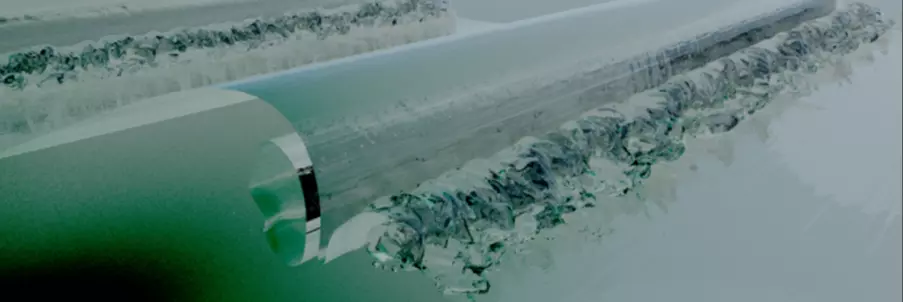
Understanding how waves break is important for understanding how the ocean is oxygenated and also how the ocean can act as a sink for carbon dioxide. The detailed distribution of water droplets and air bubbles that are produced by waves breaking can be measured experimentally, but predicting such a distribution either analytically or numerically is very challenging. Wouter Mostert uses careful numerical simulations to gain a detailed understanding of the mechanisms that give rise to particular bubble and drop size distributions [1].
Case study 2: Waveless ships
Waves generated by a moving ship are ubiquitous, but also a source of considerable 'wave drag'. What if the waves, and hence the drag, could be eliminated by a careful design of the ship's hull? Even for a two-dimensional (infinitely wide) ship, this turns out to be a difficult question that requires a very difficult and intricate asymptotic analysis [2] to resolve… partially.
Representative publications
[1] W. Mostert et al., J. Fluid Mech. 942, A27 (2022)
[2] P. H. Trinh et al., J. Fluid Mech. 685, 413 (2011)